English
 Arabic
 French
 Spanish
 Portuguese
 Deutsch
 Turkish
 Dutch
Dutch
 Italiano
 Russian
 Romaian
 Portuguese (Brazil)
 Greek
Greek

Biomass Conversion Technologies – Turning Organic Material into Energy and Chemicals
Other |
2025-10-14 17:16:46
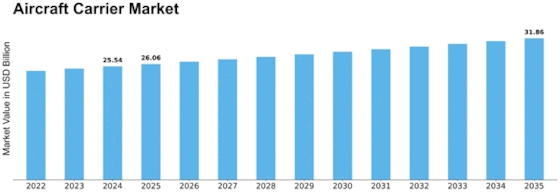
As per Market Research Future analysis, the Aircraft Carrier Market was valued at USD 25.54 Billion in 2024 and is anticipated to grow to USD 31.86 Billion by 2035, registering a CAGR of 2.03% during the forecast period 2025–2035. This growth reflects consistent investment in maritime security and naval aviation capabilities worldwide.
Aircraft carriers are the centerpiece of modern naval fleets, enabling sustained air operations across vast oceanic regions. Their ability to support combat missions, humanitarian assistance, and disaster relief underscores their versatility. As global trade routes expand and maritime security challenges intensify, aircraft carriers continue to play a critical role in safeguarding national and international interests.
Aircraft Carrier Market growth is supported by increasing defense budgets and a renewed focus on maritime dominance. Countries are prioritizing aircraft carriers to enhance deterrence and operational reach. One notable trend is the emphasis on carrier survivability, achieved through advanced radar systems, electronic warfare suites, and layered defense mechanisms.
Technological advancements are also reshaping carrier operations. Automated flight deck systems, integrated logistics platforms, and improved aircraft handling technologies are increasing efficiency while reducing crew workload. Additionally, environmental considerations are influencing carrier design, with greater focus on fuel efficiency and emissions reduction.
Leading market participants include Huntington Ingalls Industries, Thales Group, Leonardo S.p.A., BAE Systems, and state-owned naval shipyards. These companies leverage long-term government contracts and strategic partnerships to maintain their competitive positions in this highly specialized market.
Looking ahead, the aircraft carrier market is expected to benefit from the growing adoption of carrier-based unmanned combat aerial vehicles (UCAVs) and enhanced command-and-control systems. Increased collaboration among allied navies and multinational defense initiatives will further expand growth opportunities.
Discover More Research Reports on Aerospace & Defense By Market Research Future